Leadership Begins in Childhood
Your support builds confident, responsible young leaders who transform communities.
Why Childhood Is the Time to Begin Developing Leadership
When we think about leadership, we often picture adults in positions of authority. We imagine people running organisations, shaping policy, or leading movements. Yet leadership does not begin in adulthood. It begins much earlier, when children start forming beliefs about who they are, whether their voice matters, and whether they can influence the world around them.
The foundations of leadership are formed at the same time as identity.
In parts of rural Zambia, only 1 in 33 young people from disadvantaged backgrounds complete secondary school. Even the most capable children rarely have the opportunity to combine lived experience with knowledge, ambition and practical skill to solve their community’s problems.
If we want homegrown solutions to poverty’s intransigent challenges, we should not be waiting for universal access to basic education before we consider what we can do to nurture leadership.
What research tells us
Research across neuroscience, psychology and education consistently shows that the building blocks of leadership are shaped in childhood and early adolescence.
Executive function and self-regulation, described by the Harvard Center on the Developing Child as core skills for life and learning, include emotional regulation, attention control and flexible thinking. These capacities determine whether a young person can manage stress, plan ahead and recover from setbacks. They are the internal tools that make responsibility and thoughtful decision-making possible.
Economists such as James Heckman have demonstrated that early investment has a multiplier effect. Skills build on skills. When strong foundations are formed early, later education and training become more effective. Leadership development follows the same pattern. It cannot be added at the end of schooling. It grows through repeated opportunities to practise agency and responsibility.
Adolescence represents a critical window. It is a period of rapid brain development when identity forms and ambition expands or contracts. If we wait until adulthood to speak about leadership, we miss the moment when belief is being shaped.
The Pestalozzi Leadership Pathway
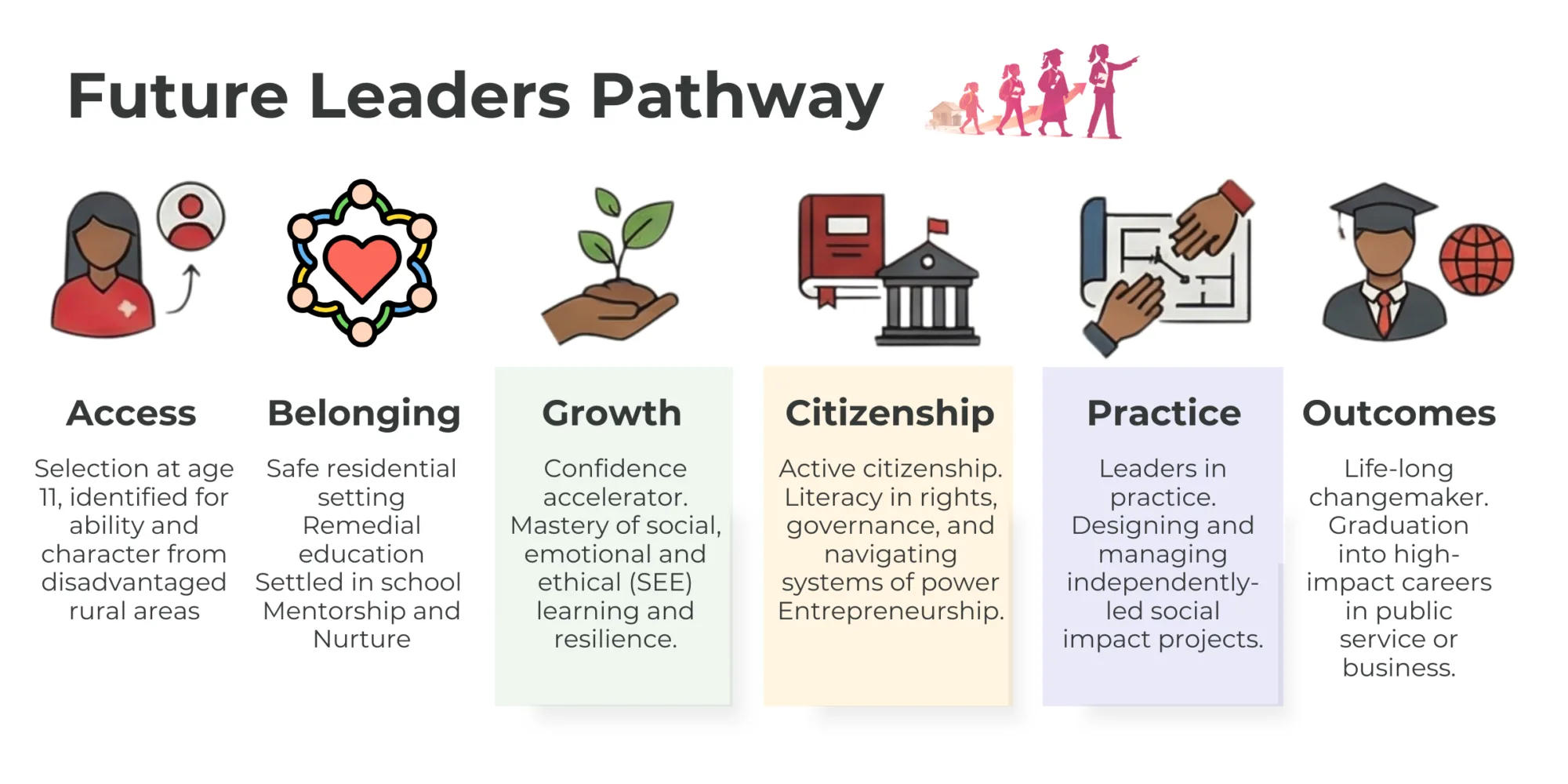
At Pestalozzi International, our response is intentional and structured. We do not treat leadership as an outcome that appears at graduation. We build it progressively through the Pestalozzi Leadership Pathway.
Belonging
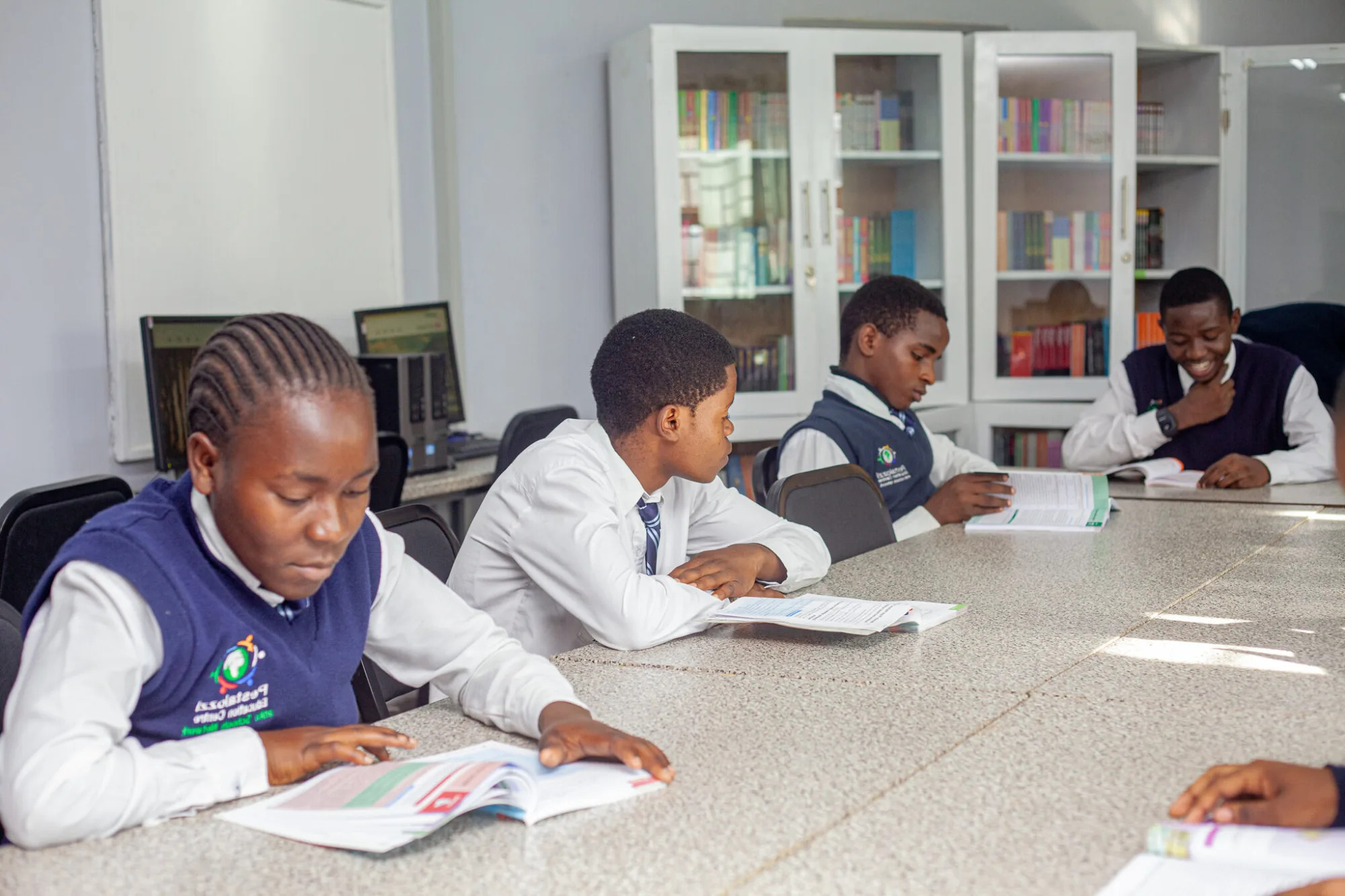
The journey begins at age 11, with stability and inclusion. Students arrive from rural and low-income communities and enter a safe residential environment where expectations are high, and support is consistent. At this stage, the focus is on safety, structure and community. Young people learn that they belong and that their presence matters.
Growth
The Growth stage addresses mindset and identity. Through the Confidence Accelerator, students engage in Mindset Camps that use physical challenges to demonstrate their ability to overcome, as well as in Social, Emotional, and Ethical Learning. They build resilience, emotional regulation and ethical judgement.This stage is critical because poverty is not just material; it is also psychological. Scarcity, trauma and low expectation can quietly limit ambition and self-belief. Without intentional intervention, these experiences shape identity for life. The Growth stage ensures that confidence, resilience, and a sense of leadership identity are deliberately strengthened.
Active Citizenship
Students develop civic literacy, financial confidence and digital responsibility. They learn how governance systems function, how power operates and how institutions can be engaged constructively. Debate forums, governance workshops and community advocacy activities build systems literacy and public voice. Leadership requires understanding how decisions are made and how influence is exercised. This stage equips students with that knowledge.
Leaders in Practice
The final stage of the programme culminates in a capstone leadership year. Students design, fund and deliver real social impact projects under supervision. They learn project planning, budgeting, safeguarding and monitoring. Leadership is no longer theoretical. It is practised with accountability. By the time students graduate, they have experienced leadership in increasingly real contexts over several years.
We describe our holistic delivery method as Head, Heart and Hands, integrating academic strength, ethical grounding, and practical action. However, it is the Leadership Pathway that provides the progression. It ensures that childhood development translates into adult contribution.
The pathway also includes targeted strands that respond to structural barriers. Our Girls Leadership and Agency strand ensures that girls move beyond access to visible leadership in communities where women have historically been underrepresented.
Across every stage, the objective remains consistent: to combine lived experience with knowledge, confidence and practical capability, and to keep young people rooted in the communities they understand best.
What impact do we see?
The results of early and sustained leadership development are measurable. 98% of our students complete the Future Leaders Programme. They are 7 times more likely to attain a university degree independently (through scholarships they earn) than the national average. 70% either enter public service careers or volunteer in their communities. Many do both. More than fifty NGOs have been founded or are led by alumni.
These numbers represent leadership in action. 97% remain in their home countries, contributing to brain GAIN.
Denise grew up in a refugee settlement in Zambia. Through the Growth phase, she strengthened her belief in her own agency. Through Active Citizenship, she developed systems awareness and civic voice. Through Leaders in Practice, she translated insights into action by founding an initiative to help pregnant teenage girls remain in education in the refugee camp she comes from. Today, she is a MasterCard Scholar studying International Relations and aspires to work with UNHCR. Her leadership did not begin at graduation. It began when she was a child, and her development was intentionally supported.


A message to supporters and partners
Developing leadership in childhood requires patience and conviction. It requires more than access to schooling. It demands structured opportunities for responsibility, reflection and action over many years.Our experience, supported by research, shows that when leadership development begins early, it shapes identity, strengthens agency and widens ambition.If we want leadership that is grounded, accountable and compassionate, we must begin where leadership truly begins.
In childhood.